Every engagement starts and ends with the innovation equation. My role is to help leaders see where their organisation is out of balance, get past the symptoms to the root cause, and bring the equation back into balance. Everything else in my approach serves that purpose.
The innovation equation
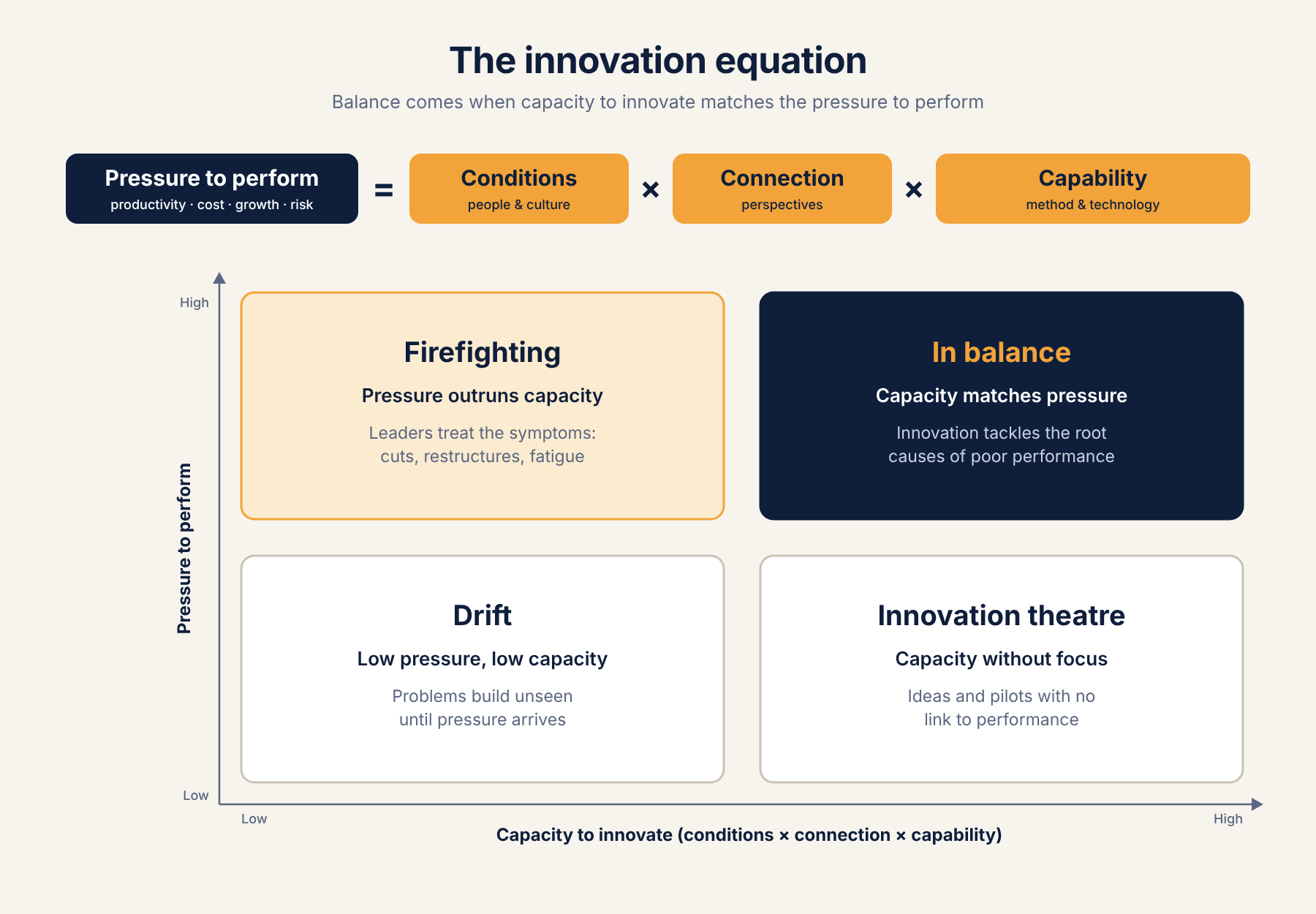
- Pressure to perform: the productivity, cost, growth, risk and service demands on the organisation
- Conditions: the culture that lets innovation flourish: safety to speak up, curiosity, leadership attention and permission
- Connection: the perspectives brought together: leaders, staff, customers, communities and outside views
- Capability: the method and technology to surface, test and scale ideas
The three parts of capacity multiply, so a strong one cannot make up for a missing one. Excellent technology without the safety to speak up still delivers close to nothing.
Bringing the equation into balance
- Diagnose the imbalance: where the organisation sits, and which element is weakest
- Separate symptoms from causes: use guiding questions to get to the root of poor performance
- Strengthen the weakest element: through the Catalyst Incubator, with people and culture at the heart
- Keep it in balance: build the conditions so the equation holds as pressure changes
Conditions: people and culture at the heart
People and culture are the Conditions in the equation, and the element most often missing. Innovation is not something done to an organisation; it comes from within.
- Permission to speak up: people at every level feel safe to question assumptions and share what they know
- Curiosity over certainty: leaders ask before they answer
- Openness to difference: challenge from other perspectives is welcomed, not avoided
- Shared ownership: people see innovation as their job, not something done to them
Connection and capability: people-led, technology-enabled
People-led at the centre, surroounded by technology-enabled capabilities.

People-led is how I build Connection: the insight, judgement and ownership come from leaders, staff, customers and communities.
Technology-enabled strengthens Capability: AI, data, analytics and digital tools make that human process faster, broader and sharper.
- Hear more voices: gather and make sense of input from hundreds or thousands of staff and customers
- Find the patterns: surface themes, pain points and opportunities that would otherwise stay hidden
- Test bias: hold assumptions up against evidence
- Validate faster: prototype, model and test ideas before committing investment
- Scale what works: deliver lasting gains in productivity, cost and service
Technology serves the people, never the other way round.
The six elements: testing each part of the equation

1. The right problem
Pressure to perform. Innovation fails when it solves the wrong thing well. Robust innovation starts with a clear, shared understanding of the root cause, not just the symptoms.
The question I ask: “If we solved this, what would actually change?”
2. Diverse perspectives
Connection. No single group sees the whole picture. I deliberately bring together leaders, frontline staff, customers and outside viewpoints, including those who would see it differently.
The question I ask: “Who sees this problem in a way we don’t?”
3. Productive challenge
Connection and Conditions. Every perspective carries learning and bias. Robust innovation puts them up against each other, in an environment where that is safe, so assumptions are tested and new possibilities appear.
The question I ask: “What are we assuming, and who would disagree?”
4. Evidence of value
Capability. Good ideas are not the same as needed ideas. Robust innovation is validated with the staff and customers it affects, before investment.
The question I ask: “How do we know people would actually value this?”
5. Proven feasibility
Capability. Ideas fail at the point of delivery. Robust innovation is tested early by the people who would have to make it work.
The question I ask: “What would it take, and what would stop it?”
6. Ownership
Conditions. Solutions done to an organisation are resisted. Solutions that come from it are adopted and sustained.
The question I ask: “Whose solution is this?”